


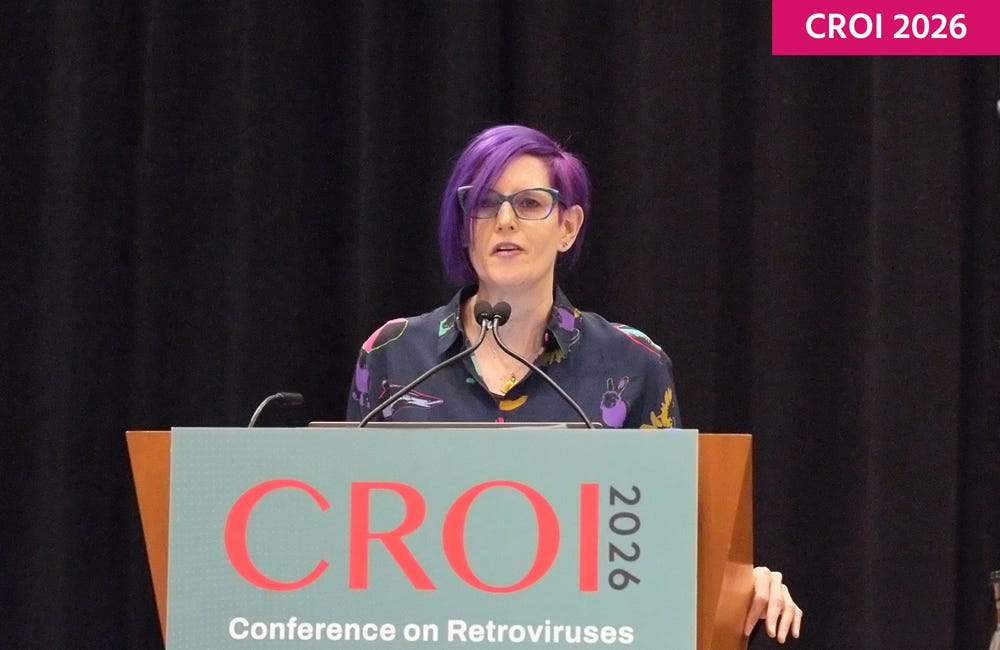
The 33rd Conference on Retroviruses and Opportunistic Infections (CROI) convened February 22nd – 25th in Denver under extraordinary tension between a pipeline of HIV prevention, treatment, and potential cure tools that could reshape the epidemic’s trajectory, and a global funding crisis actively dismantling the infrastructure required to deliver any of it. As Conference Chair Nicolas Chomont of the Université de Montréal stated in the Opening Session, “we share a responsibility to defend and sustain funding for international HIV programs and research.” That charge framed every session that followed.
The Funding Crisis: New Data on the Damage
The consequences of disruptions to the U.S. President’s Emergency Plan for AIDS Relief (PEPFAR), the dissolution of the United States Agency for International Development (USAID), and National Institutes of Health (NIH) cuts are no longer hypothetical. The CROI session “Sleepless in Denver” presented the first systematic evidence of the damage. Ellen Brazier’s survey data from the International epidemiology Databases to Evaluate AIDS (IeDEA) consortium found that across 32 countries, 47% of clinics reported disruptions in HIV services, with similar rates of disruption to medication availability, laboratory services, and clinic operations. In KwaZulu-Natal, South Africa, Lindsey Filiatreau reported that 39% of clinics experienced disruptions affecting an estimated 830,000 people living with HIV.
The damage is not confined overseas. Aaron Richterman presented data from a rapid survey across three U.S. states showing that 47% of clinics reported HIV service disruptions, including medication shortages. He also demonstratedhow cuts to the Supplemental Nutrition Assistance Program (SNAP), the country’s largest targeted anti-poverty program serving more than 42 million Americans, directly undermine treatment outcomes. During the 2025 government shutdown, ART adherence among people living with HIV who receive SNAP benefits dropped to as low as 40%. The connection between food security and viral suppression is well established; cutting one predictably undermines the other. As Filiatreau put it, “These things [HIV services]… can be taken away overnight, but they can’t be rebuilt overnight.”
Prevention: An Expanding Toolkit, a Widening Access Gap
Against this backdrop, CROI delivered a prevention portfolio that is broader and stronger than at any previous conference. Final results from the PURPOSE 1 and PURPOSE 2 trials confirmed the efficacy of twice-yearly injectable lenacapavir for pre-exposure prophylaxis (PrEP). In PURPOSE 1, which enrolled cisgender adolescent and young women in sub-Saharan Africa, HIV incidence among lenacapavir recipients was 0.07 per 100 person-years, compared to 1.98 for oral emtricitabine/tenofovir alafenamide (F/TAF) and 1.94 for emtricitabine/tenofovir disoproxil fumarate (F/TDF), with only two seroconversions among more than 2,000 participants. PURPOSE 2, enrolling men who have sex with men and gender diverse people, showed HIV incidence of 0.11 per 100 person-years for lenacapavir versus 0.92 for F/TDF, with three seroconversions among 2,179 participants.
The five total seroconversions across both studies received considerable attention, with four showing lenacapavir-associated resistance mutations that researchers believe developed during PrEP rather than being transmitted. Research into why these breakthroughs occurred is ongoing. As Gilead’s Stephanie Cox stated, “We don’t know why these occurred… I think the efficacy is very high.” San Francisco AIDS Foundation (SFAF) Medical Director Hyman Scott, MD, MPH, added context: “The breakthrough infections are important to evaluate but are extremely rare among the thousands of study participants.”
The Prévenir study’s final eight-year results from France reinforced that both daily and on-demand oral PrEP are safe and effective, with overall HIV incidence of 0.11 per 100 person-years across more than 3,200 users and 13,000 person-years of follow-up. Switching between daily and on-demand use was the norm rather than the exception, with 59% of daily users changing to on-demand at least once, and 52% doing the reverse. This carries a clear message for implementation: people need flexibility, and rigid one-size prescribing undermines persistence.
The prevention pipeline continues to expand. Merck’s once-monthly oral PrEP candidate MK-8527 selected an 11 mg dose maintaining protective drug levels in at least 95% of participants, with Phase 3 EXPrESSIVE trials now enrolling. Gilead’s PURPOSE 365 study, testing once-yearly lenacapavir for PrEP, is being designed. The SEARCH study showed that community health workers paired with digital tools reduced HIV incidence by 70% in rural populations, a reminder that prevention tools work best when embedded in community-driven delivery.
The problem is reach. Andrew Hill highlighted that only 2.3 million people are currently on oral PrEP, far below UNAIDS targets, and that injectable cabotegravir and lenacapavir represent just 2.9% and 0.9% of total PrEP use, respectively. We have a growing menu of prevention tools. Getting them to the people who need them is where the system breaks down.
Treatment: More Options, Longer Intervals, Patient Choice
The treatment pipeline at CROI 2026 moved toward a central goal: giving people living with HIV more choices that fit their lives. Merck presented late-breaking data from three Phase 3 trials of doravirine/islatravir (DOR/ISL), the first ever once-daily, non-INSTI two-drug regimen. In treatment-naive adults, DOR/ISL demonstrated non-inferiority to bictegravir/emtricitabine/tenofovir alafenamide (BIC/FTC/TAF), with 91.8% achieving viral suppression at Week 48 compared to 90.6%, including participants with high viral loads and low CD4 counts. The U.S. Food and Drug Administration (FDA) has set an action date of April 28, 2026 for the DOR/ISL application. For people aging with HIV who manage multiple comorbidities, a two-drug, non-INSTI regimen addresses a real clinical gap. Research presented at this same conference linked the widely used INSTI dolutegravir to neuropsychiatric effects, including blocking a brain enzyme essential for memory and emotional regulation, with one study halted for ethical reasons after participants experienced worsening symptoms. For people navigating tolerability concerns, toxicity issues, or polypharmacy, having a non-INSTI alternative with fewer active agents matters.
Gilead’s ARTISTRY-1 and ARTISTRY-2 trials demonstrated that a bictegravir/lenacapavir (BIC/LEN) single-tablet regimen can maintain viral suppression for people switching from complex multi-tablet regimens (96% at 48 weeks in ARTISTRY-1) or from Biktarvy (93.5% in ARTISTRY-2). For people who have been on complex regimens for years due to resistance histories, this potential simplification addresses a real quality-of-life gap. Gilead plans to submit these results to regulatory authorities.
Long-acting injectables continued their forward march. In ViiV Healthcare’s EMBRACE study, lotivibart (a broadly neutralizing antibody, or bNAb) given as an IV infusion every four months plus monthly cabotegravir maintained viral suppression in 94% of participants at 12 months. Part 2 of EMBRACE, testing lotivibart infusions every six months, is now fully enrolled. ViiV also presented early data on VH-184, a third-generation integrase inhibitor with potential twice-yearly dosing, and VH-499, a capsid inhibitor supporting twice-yearly intervals. The VOLITION study showed that 85% of treatment-naive adults opted to switch from daily pills to bimonthly long-acting cabotegravir/rilpivirine (CAB+RPV LA), with 95% maintaining suppression. Data like VOLITION’s 85% opt-in rate reinforce what the HIV community has long argued: when people living with HIV are offered options that fit their lives, they take them. Payers, formulary committees, and ADAP programs should take note. Treatment is not one-size-fits-all, and coverage shouldn’t treat it as such.
Community activist Shari Margolese put it plainly at CROI’s final Community Breakfast Club: “As a community we need to get much angrier about the fact that we can’t get access to the drugs.” Francois Venter of Ezintsha in South Africa warned that without action, “we might be sitting here again in 10 years’ time” celebrating breakthroughs that never reach communities.
Cure, Comorbidities, and the Equity Question
On the cure front, the RIO trial’s Phase B results offered genuine encouragement. Among the 28 people who received a placebo in Phase A and were then given bNAbs teropavimab and zinlirvimab, 54% had prolonged viral remission after stopping antiretroviral therapy (ART), with two still off treatment after more than a year. Because ART was stopped six months after the bNAb infusions, these results point to an immunological “vaccinal effect” rather than direct viral suppression. A cure remains distant, but these are the kinds of incremental, well-designed steps that build the evidence base forward.
CROI also highlighted the growing urgency of managing comorbidities in aging populations living with HIV. The POPPY study found that depression affects 32.4% of people living with HIV over 50, linked to inflammatory markers rather than psychosocial factors alone. A study of over 1,500 men showed that the combination of age 65 and over, HIV, and metabolic syndrome produced significantly worse cognitive impairment than any factor alone. Metabolic syndrome is the modifiable factor in that triad, which means clinicians and patients can act on it now. CROI data on GLP-1 receptor agonists like semaglutide point toward a potential tool for doing so: in a study of people living with HIV-associated lipohypertrophy, semaglutide produced a 19% reduction in total body fat, a 31% decrease in visceral adipose tissue, and a nearly 50% drop in C-reactive protein, a key inflammatory marker. Separate data presented at the conference found that semaglutide did not worsen depression in people living with HIV, and that people with moderate or severe depression at baseline actually showed improvements. These findings warrant dedicated research into how GLP-1 therapies can address the long-term health consequences of chronic inflammation and aging with HIV. If the evidence continues to support their role, GLP-1 receptor agonists should be evaluated for inclusion in the HIV standard of care, with appropriate insurance and program coverage to match.
The equity question came into sharp focus with data from the ENCORE cohort. Black trans women in the U.S. had an HIV incidence of 15.5 per 1,000 person-years, compared to 1.4 for White trans women. Poverty, houselessness, and lack of insurance were significant drivers, and only 4% of trans women in the cohort used long-acting injectable PrEP. Dr. Sari Reisner of the University of Michigan warned that the current administration’s erasure of gender identity data from federally funded datasets will make it harder to monitor disparities and determine what works. We cannot close gaps we refuse to measure, and they know that.
What Comes Next
CROI 2026 produced a clear picture: we have tools that can change the course of the HIV epidemic, and the systems required to deliver them are being actively undermined. The path forward requires specific action. We must defend and restore funding for PEPFAR, NIH, and the global HIV infrastructure that makes science reach people. State ADAP programs and payers must expand coverage for long-acting prevention and treatment options and remove administrative barriers that delay access. To do that, they need to be adequately funded. PrEP implementation must embrace the full range of validated modalities, from daily oral to on-demand to injectable to monthly oral, with flexibility built into delivery. Care for people aging with HIV must shift toward whole-person approaches that integrate cognitive screening, metabolic risk management, and mental health support alongside viral suppression. And we must protect the community-led surveillance and data collection that allows us to see and respond to disparities, especially for trans and gender-diverse communities.
Wes Sundquist of the University of Utah, who helped develop the science behind lenacapavir, reflected at CROI on the decades-long journey that produced this tool. He warned that while the field now has “a really powerful new tool in the arsenal,” forces are blocking its use. “It will be a human tragedy,” he said, “if we don’t overcome those.” The science has done its part. The rest is a question of political will, policy design, and whether we as a community can sustain the pressure long enough for these tools to reach the people who need them.